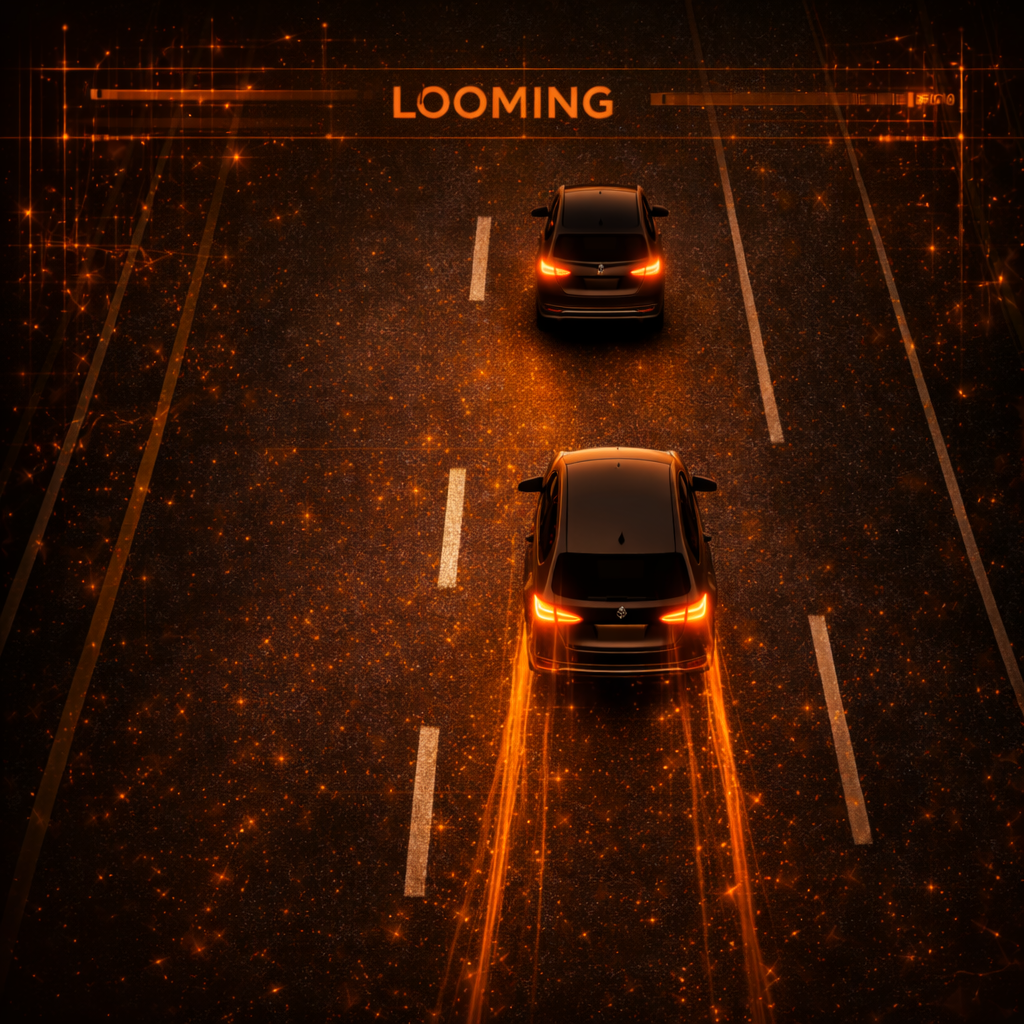
Looming
Looming collisions are high-speed, rear-end collisions involving a slow-moving or stopped vehicle in the lane of travel. Human factors experts address the issue of looming in vehicle collision cases to determine whether the driver perceived and responded to the slower moving or stopped vehicle in a reasonable amount of time and whether the driver’s actions were a cause of the crash.
What is looming?
Many vehicle crashes involve a driver rear-ending a slow-moving or stopped vehicle on the highway. These crashes often involve vehicles that have recently entered a lane of travel but have not yet accelerated to highway speeds or disabled vehicles that have slowed or stopped in the lane of travel. A driver’s ability to avoid rear-ending a slow-moving or stopped lead vehicle depends on a number of factors, but almost always depends on a driver’s ability to detect their rate of closure to the slow-moving vehicle. While drivers can easily determine that they are approaching or getting closer to a leading vehicle, it is difficult for drivers to estimate closing speed, or how quickly they are approaching the lead vehicle, until the vehicles are close together. In the field of human factors, the perception of the rate of closure to a lead vehicle is commonly referred to as “looming.”
Human Factors Investigations of Looming Collisions
A human factors investigation of a rear-end collision involving a slow-moving or stopped vehicle on a high-speed road includes:
- Calculating the point of looming detection (the distance at which a driver would be expected to perceive their rate of closure to a slow-moving or stopped vehicle)
- Determining the appropriate perception-reaction time for the driver confronted with a looming collision scenario.
- Analyzing whether there was sufficient information available in the roadway environment for a driver to determine that the lead vehicle was either stopped or moving slowly without having to perceive looming.